“What do you think about it Michael?” I’ve just walked into the doctor’s mess at lunchtime and the person posing me this question is my friend Andy, a junior surgeon.
“What do I think about what?” I say as I pull up a chair and open up my lunchbox.
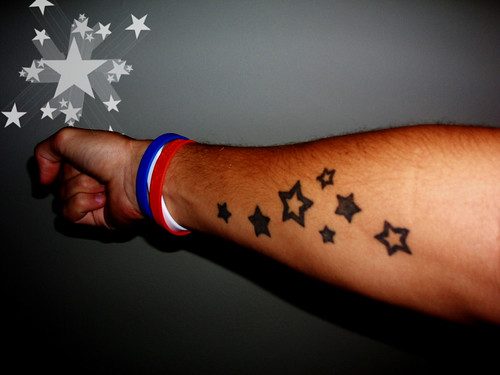
“I’m thinking of getting a tattoo – but I’m not sure if it’s a good idea. People might look down on me because of it and I’m not sure that people will like it.”
“What are you going to get?”
“I don’t know, some sort of pattern – here on my arm” he says as he point to his forearm.
“Personally, I think tattoos there are pretty cool. If you want one, you should go for it.”
“Yeah – but what if the bosses don’t like it?”
“I wouldn’t worry too much about that – it’s your body after all and you can always cover it up.”
“Bare below the elbows, Michael!”
“Oh yeah, I forgot about that, you’re quite right, though I think we should take the ‘bare below the elbows’ thing with a pinch of salt.”
“And people will see it when I’m scrubbing up and stuff.”
“You’ve also go to think about what the patients might think,” pipes up Jo, one of the medical house officers.
“To be honest, I really don’t think that patients care,” replies Andy. “It’s more what my colleagues think that worries me.”
“To be honest with you Andy,” I interject, “I know that personally, I’m far too fickle to have a tattoo, but if I wasn’t and I found one I really liked, I’d probably get it done. But it’s up to you. All I’d say is that you should decide if you want it and if you do, go for it and not worry too much about what other people think.”
Andy furrows his brow, “Hmmm… perhaps you’re right, perhaps not. Watch this space.”
I’ll be watching with interest.
Thursday, 2 April 2009

Tuesday, 31 March 2009
Today was a good day.
Today was a really good day. I was working with a really nice consultant and a really nice surgical team. The patients were friendly and happy and they’d all been worked up properly with all the appropriate pre-op investigations done and documented. There was lots of laughing all joking all day and all the operations went smoothly. When I went to see the patients after their operations, they were all comfortable and smiling.
Because the clocks have now gone forward, it was light enough to go for a lovely walk after dinner. It was one of those days that makes you feel really glad to be alive.
Today was a good day.
Friday, 27 March 2009
When it all goes wrong
Some of the people that I work with have told me that I worry too much about things. Before anaesthetising a patient I check, check and check again. I do things that most deem unnecessary, and it’s been commented on a few times. I usually laugh it off and say that my paranoia keeps me sane. Sometimes it causes friction with my colleagues – I remember practically having a shouting match with the A&E charge nurse because one night I insisted on giving a general anaesthetic for emergency cardioversion in A&E resus rather than taking the patient to the Coronary Care Unit. I’m sure that as I become more experienced, I’ll “loosen the reigns” a little, but I think that I’ll always bring a healthy dose of paranoia with me to work.
The reason for this is that in anaesthetics, when things go wrong, they go BADLY wrong and they go badly wrong very quickly indeed. Yesterday, I was shown something that really crystallises this message.

The reason for this is that in anaesthetics, when things go wrong, they go BADLY wrong and they go badly wrong very quickly indeed. Yesterday, I was shown something that really crystallises this message.
“A mother who spent years undergoing IVF treatment died after a bungled birthand never saw the baby she longed for, an inquest was told yesterday.
Joanne Lockham had a Caesarean operation to deliver baby Finn but her brain was starved of oxygen for up to 30 minutes, it was claimed.
Within moments of the birth she suffered a heart attack and she died two days later after sustaining massive irreversible brain damage."
Reading a bit further into this story we learn that basically, the decision was made to give Mrs Lockham a general anaesthetic for her ceasarian section, after giving her the anaesthetic, the anaesthetist couldn’t put the breathing tube in the right place (couldn’t intubate) despite several attempts. By the time help arrived, she was already dead.
“…problems arose in the operating theatre. The jury heard that three attempts were made by anaesthetist Dr Prasad to insert a tube to give Mrs Lockham oxygen before it was eventually believed to have been successful.
Dr Prasad broke down in the witness box as he told how he repeatedly tried to intubate Mrs Lockham.”
It sounds like several things went wrong here but I’m not going to comment too much about the ins and outs of this case because I wasn’t there and don’t know all the facts, but I will say this. In situations like this, when things start to go a bit wrong, people start to panic. This is ESPECIALLY true on the labour ward. The midwives panic, the obstetricians panic, the scrub nurses panic and everyone starts telling you, as the anaesthetist to hurry up and get the patient to sleep. It’s noisy, the atmosphere is fraught and if the anaesthetist starts to panic, then things become INCREDIBLY dangerous. It sounds like Dr Prasad panicked.
“Dr Prasad said: 'I was doing my job, but I was in a complete state of shock, I couldn't think, I was trying to be useful in anything I could.
'I went in at that point in time with a particular plan and it didn't happen.
'It was completely out of the blue and the equipment was not giving way, so I didn't
know what to do, it completely numbed me, it was not what I was expecting.'"
This is a horrible situation for everyone and highlights the point that I’ve been told several times during my training – always be clear what your exit stratey is. The books say that Dr Prasad should have prevented the obstetricians from starting the caesarian section, woken Mrs Lockham up and waited for senior help to arrive. However, I can see that this is difficult to do when you have the consultant obstetrician and a room full of midwives yelling at you to hurry up and get the mother to sleep because “they need to get the baby out.”
This brings me back to my original point. I’ve not yet been in a situation like the one above by myself, but sooner or later, it’s goint to happen. Things are going to go wrong unexpectedly with one of my patients. At least if I’ve checked everything and know where everything is, when the panic starts to creep up on me, it reduces the amount of “thinking” I have to do and hopefully gives me more of a chance of sorting the situation out long before it gets to the stage that Mrs Lockham go to.
What happened to Mrs Lockham is truly tragic. Dr Prasad would have had to explain to her husband why he now has to bury his wife. What should have been a joyous occasion has become a horribly tragic one. Everybody involved will have to live with what happened for the rest of their lives. A child will grow up never knowing his mother.
My condolenses to Joanne Lockham’s family.
Thursday, 26 March 2009
An army marches on its stomach

In my hospital, there is nowhere where the staff can get a hot meal. I’ve been told that my hospital is one of the largest single employers in the town and it provides healthcare round the clock, every single day of the year. If you work in my hospital, you are expected to work 8-, 10-, 12-, 13- or even 24-hour shifts, depending on what you do, but despite this, there is nowhere that you can purchase a decent meal in all the time you’re on duty. To make matters worse, because of the location of the hospital, there isn’t anywhere nearby that people can pop out to and get some grub.
You have to either bring your own food in with you, choose from a selection of cold sandwiches and salads at the WRVS counter or at night (if it’s not too hectic) you can sometimes order a take-away to be delivered.
The reason I’m posting about this is because at the weekend I was introduced to a friend of a friend who was a fireman. We swapped stories about our jobs and one of the things that he told me was that at their station, they have hot catered food on site. Not gourmet platters, not fancy Heston Blumenthal-eque dishes, but hearty, hot food that they can buy when they’re on duty.
I know that the catering provision is pretty far down the priority list for those that run the hospital, but I can’t help but think that some sort of on-site hot food provision would make the hospital a happier place to work in. They say that an army marches on its stomach and, considering that the hospital employs so many people day and night, surely this can’t be so hard to achieve?
Wednesday, 18 March 2009
Satire

The guys over at The Daily Mash are at it again. Apparantly, Stafford Hospital is still "better than homeopathy" despite the following...
You can read the full story here.
Stafford Hospital pioneered the introduction of a doctor-free health system by filling all its senior surgical and medical positions with bean bags, the semi-literate children of Bulgarian immigrants and enthusiastic local dogs.
One of its main innovations was a drive-in morgue which allowed ambulances to deposit live patients directly into the mortuary, sometimes days earlier than would have been the case had they just been left to die in a corridor in line with NHS targets.
You can read the full story here.
Thursday, 12 March 2009
Chocolate Tax

I just came in from work, flicked the telly on to BBC news and was greeted by a story on Dr David Walker, a Scottish GP, who thinks that chocolate should be taxed.
"There is an explosion of obesity and the related medical conditions, like type
2 diabetes. I see chocolate as a major player in this, and I think a tax on
products containing chocolate could make a real difference."
My first thought was, “surely he can’t be serious?” and, judging by the smirk on the newsreader’s face after the piece, I don’t think she was taking him seriously either.
The problem is, that while Dr Walker’s underlying message makes sense (too much chocolate is bad for you), by suggesting taxation as a solution, he reveals that he doesn’t have the most basic grasp on economics, psychology or plain old-fashioned common sense.
Chocolate is cheap, really cheap. Exactly how much tax are you going to have to put on it to stop people buying it? Even if you doubled the price of a Mars bar from 50p to £1, do you think it will prevent anyone at all from buying them? And which political party in their right mind is going to support such a tax anyway?
Dr Walker is an intelligent man, but by shooting his mouth off about economic policy, something he obviously knows nothing about, he’s ended up looking like a total tit.
Now, where did I leave that Galaxy bar?
Sunday, 8 March 2009
Made his own bed to lie in
I was just browsing some of the things I've written when I found this post from last year...
-------------------------------------------------------
I answer my pager and listen to what Tal, the orthopaedic surgeon, says to me down the phone. I sit on the intensive care unit (ICU) and my heart sinks a little as he explains the story. It’s 3 a.m. on my third night on the trot and, to be honest, I’d been semi-expecting a call like this at some point. I sigh and tell the surgeon that I’ll be down to A&E soon. As I leave ICU, I scoop up some drugs and let the ward sister know where I’m heading. She rolls her eyes as I tell her what’s going on. “I know.” I respond, “I just don’t understand what some people do for kicks.”
I take a stroll down to A&E through the empty corridors of the hospital. My clogs create a faint echo with every step I take. I have a few moments to think about what I’m about to see and have to deal with and I surprise myself a little. You see, the main emotion I’m experiencing is not fear or excitement and it’s not sympathy or concern. It’s irritation. I’m annoyed by the situation that I’m being called to help sort out. I know that I took an oath to “make my patients my first concern,” but, despite myself, already I’m thinking that the man I’m about to meet in A&E is a bit of a dick.
A&E is busy, which is not surprising seeing as it’s Friday night, and as I wander through the department looking for Tal, I spy my punter. To be honest, I hear him before I see him. He’s shouting, he’s obviously in an awful lot of pain and he’s obviously very, very drunk.
Tal is in the doctors’ office scribbling some notes and he looks up at me as a walk in.
“The guy round the corner?” I ask, somewhat rhetorically.
“Yeah, sorry about this,” Tal replies. “He’s had 10mg of morphine from the paramedics, I gave him another 10 before I called you, he’s got some Entonox, but as you can hear, he’s still in agony.”
“Hmmm,” I grunt. “And his injuries are where, exactly?”
“Well, he’s lost two fingers and has a deep laceration going across his whole palm.”
“So, all three nerves then?” I enquire, referring to the three nerves that supply the hand: the median, the radial and the ulnar.
“Yeah, we haven’t dressed the wound yet, so you can look for yourself.”
“Cheers,” I say and smile at Tal. I can tell that he’s just as unimpressed with the situation as I am. I think there’s a bond that develops between hospital workers when you have to deal with situations like this in the middle of the night. “Tell me again, what happened to this guy.”
“Well, he says he got into an argument and thought it would be a good idea to light a firework and throw it at the other guy.”
“As you do…”
Tal laughs dryly, “As you do. Anyway, the firework goes off, the flames scorch his hand and then it explodes and blows his fingers off.”
I picture the scene in my head, it’s like something from a cartoon. It would be pretty comical if it hadn’t ended up with the guy in hospital “Why on earth did he think that throwing fireworks would be a good idea?”
Tal shakes his head. “I don’t know, I didn’t go into it. To be honest, he’s so pissed that it’s hard to get any sense out of him at all.”
“What’s his name again?”
“Simon.”
“OK, I’ll go see what I can do.”
Simon is sitting on a trolley with his girlfriend and his Dad next to him. The two of them are sober and obviously really worried. Simon, on the other hand, is not. He’s totally off his face and is singing a Girls Aloud song between cries of pain. I introduce myself, but Simon’s not really paying any attention to me.
“It hurts! It hurts!” he yelps
“Of course it hurts,” I say. “I’m going to give you a couple of injections to help with the pain. They sting a bit when they go in, but it won’t be anywhere near as band as your injury.”
“It’s killing me!”
“Keep using your Entonox, I’ll be back in a minute.” I go off and find a syringe, some chlorhexidine and a small needle. I return to Simon’s trolley and tell him, “Right, I need to take a look at this.”
“I don’t want to see it!” he yelps.
“I need to see what I’m doing.” I respond, firmly. “If you don’t want to see it, close your eyes.” Simon keeps his eyes open and stares intently at what I’m doing. I shrug.
I remove the Incopad that Tal had put over Simon’s had and had a look at his injuries. Simon has lost all the skin and flesh from his middle and ring fingers leaving just the bones sticking out like something from a grotesque film. His little finger was missing altogether and a wide, deep gash ran from where his little finger should have been to the base of his thumb revealing the tendons underneath. It looked horrific. It was horrific.
“Aaargh!” yelps Simon as he catches sight of his mangled hand again. I ignore him and set about cleaning his wrist the best I can.
Simon starts to laugh. “Look at that!” he says as he lifts up his hand. He starts moving his fingers and the visible bones start to flex and bend. It’s a really surreal effect, it looks like something from a horror film. “Ha ha ha ha ha!” comes Simon’s laugh. “I bet you’ve not seen anything like this before, have you doctor?” He’s right, I haven’t. He jabs the skinless bones of his middle finger in my direction. “I bet you’ll always remember me now! Ha ha ha ha ha!”
“Simon! Pack it in! Behave yourself!” comes the sharp, reprimanding voice of his girlfriend. I look up at her and she looks really green.
“Are you OK?” I ask.
She nods. “Do you want to have a seat or maybe get a cup of coffee while I do this?”
“No, I’ll be OK, I want to stay with him.”
I turn back to Simon. He’s not really behaving like someone who, in all probability is about to lose is hand. I shrug. It’s most likely the effects of the morphine, the Entonox (a.k.a. “laughing gas”) and, most of all, the vast amounts of alcohol he’d consumed earlier in the evening.
“Put your hand down and keep still.” I tell him.
By now, Tal had come in as well because he wants to see how I do the nerve block. I talk Tal through what I’m doing, the landmarks I’m using to try and identify each of the three nerves and tell him what dose of Bupivicaine I’m using in each place.
“Right, that’s done now.” I tell Simon. “It’ll take about 20 minutes to start to work, so it the meantime, keep using the gas.”
“Will what you’ve done take the pain away?” asks Simon’s Dad.
I shake my head. “No, it’ll make the pain much less severe, but it won’t take it away completely.”
“What’s going to happen now?”
I look at Tal and he starts to explain the next steps to Simon’s Dad.
I leave them to it and go and jot down what I’ve done in Simon’s notes. My attitude towards Simon has changed since I first took the call from Tal. I still feel annoyed by him and what he’s done to himself, but now I see that how I feel about it is really not relevant to anything at all. This guy’s just lost most of his hand. When he sobers up in the morning, this realisation will hit home. There’s no point in me thinking about what a dick he’s been because every day for the rest of his life, Simon will have to live with his injuries. He’ll have to learn to write all over again, to dress himself to open jars, to do all the simple little things that we all take for granted. Every day, he’ll look down at his hand and he’ll think to himself “Why the hell did I pick up that firework that night? Why was I such a twat?”
Simon’s made his own bed to lie in and he’ll have to face up to that soon enough, my personal feelings towards him is neither here nor there. You see, I can walk away from the situation and not have to deal with it anymore, Simon doesn’t have that option.
I sincerely wish him all the best.
Subscribe to:
Posts (Atom)